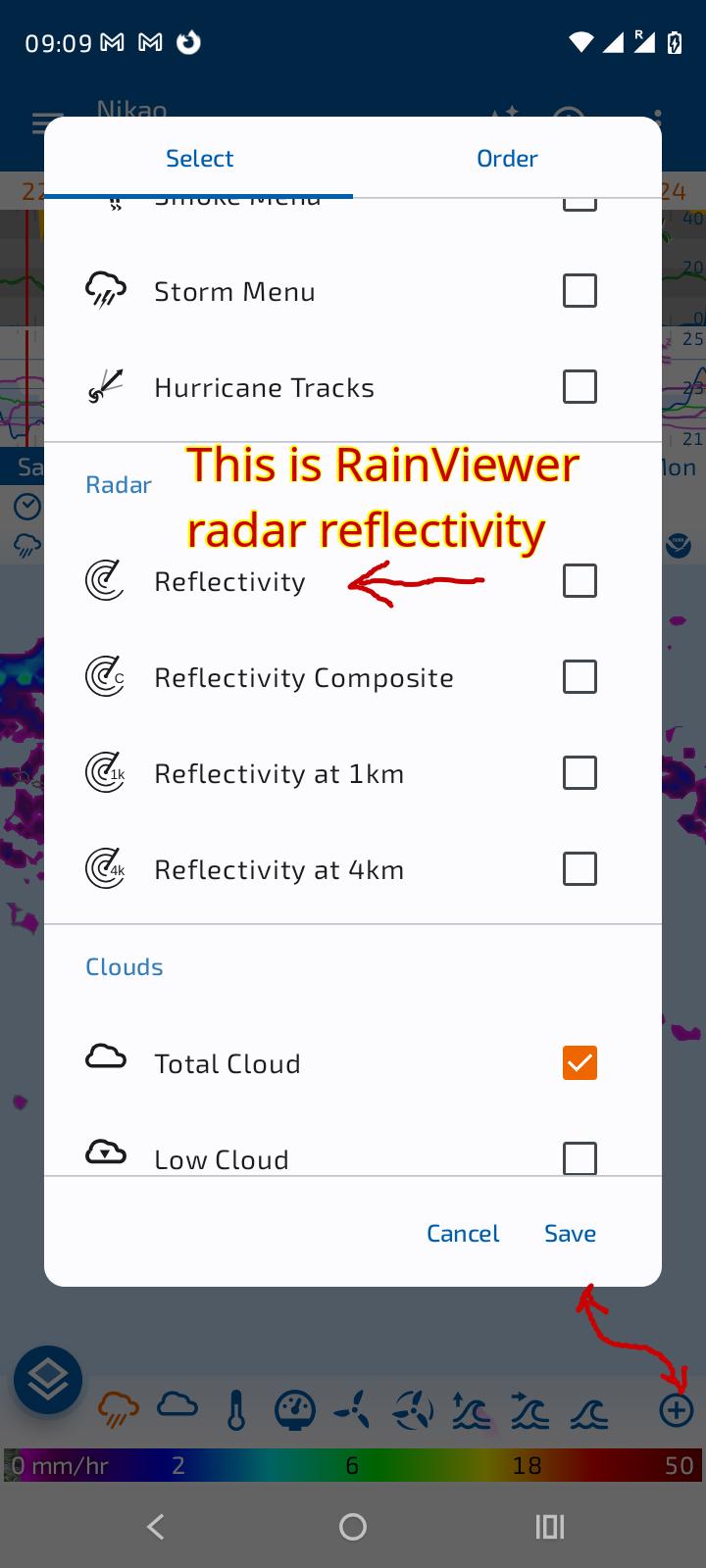
I doubt if the cessation of Rainviewer will impact you @Speed as your Flowx usage is identical to mine.
I’ve never had Reflectivity selected as an option as I use an Australian BOM radar app to see historical rain and Flowx to see probable future rainfall patterns and amounts.
That’s a habit of mine with any weather app I’ve ever used … I’ve been looking at the same BOM radar for 30 yrs on the internet (plus many decades before that on TV) so it never occurred to me to see if Flowx had that feature.
So I just selected Reflectivity and turned it on. I’ll admit it’s a very handy option to see historical rainfall overlaid on the same map space but I will not be inconvenienced by its removal as I’ll still be practising my same old habits with Flowx & the BOM app I use.
Cool. I think by reflectivity you’re talking about the radar. I like that Flowx lets me see the rainfall going out 16 days ahead. Very handy to me it’s the critical function. FYI my use case may be a little bit different than most people in here. I ride a motorcycle long distances and need to see what’s going on at different destinations looking forward to several days. I’m in the rain and snow and this is a big impact on motorcyclists. If I have to switch to another app to get rainfall going out 16 days into the future then I’ll probably drop Flowx.
Yep, Rainviewer is historical radar, i didn’t even think about the “Reflectivity” option until I started reading about it here!
If you turn it on it you can see up to 3 days in the past but as soon as the time cursor hits now it disappears, Flowx continues to show future forecasted rain patterns/amounts from your chosen models.
I can’t see the discontinuation of Rainviewer being a problem for you - historical rain is in your mirrors so happy road ventures!
@Speed Just as an aside: there are other users like you who use this for touring. One request is to plot your route (with timing) and the graphs show the weather for the route.
I use the radar or what is called reflectivity all the time. I see it as a rainfall predictor. I don’t care about the past, only what’s coming. So, this is the reason I pay for Flowx. Temperature prediction is the second big feature for me. Very useful and efficient to use.
It is not. It’s only a feature request and is on the todo list.
Many people use radar (reflectivity) and rainfall (precipitation) interchangeably. They are not the same thing.
Predicted precipitation is the predicted rainfall from a weather simulation.
Radar reflectivity is measured by a radar station that measures the reflection of radio waves. Radar reflectivity can INDICATE rainfall.
Furthermore, HRRR and NAM 3km weather simulations do output predicted precipitation and also predicted reflectivity. This can cause further confusion.
The only thing disappearing is the RainVIewer reflectivity data. Not the weather simulation forecast or prediction data.
RainViewer is just one data source with only one data type (reflectivity) that is disappearing. There are 26 other data source in Flowx each with at least 10 data types (precipitation, temperature, wind…).
There is far more to Flowx than just RainViewer radar reflectivity. Not only that, the 26 data source share the same code and radar reflectivity has it’s own special code just for itself. In other words, it’s disproportionately high maintenance.
@duane I think clarification of the difference should be in the first post with emphasis that Reflectivity is historical and not predictive (to the extent that modelling can predict).
It is apparent that some users may be misinterpreting the terms.
Duane, thanks but I’m even more confused now. Apparently we’re talking past each other. I have no idea what is being discontinued. All I know is that I’m talking about the “rainfall” layer. It’s called “rainfall” in the app’s “general data” ribbon. Looking in this “general data” menu I can see several “reflectivity” options. I never use them. Enabling them does nothing. Are the “reflectivity” options in the “general data” menu what’s going away? They are useless to me anyway. I depend on the “rainfall” predictions. Is this staying?
Radar reflectivity is a MEASURED indication of past or actual precipitation intensity. It is one of many inputs to weather SIMULATION software systems (e.g. GFS) that provide expected future weather situation, e.g. future precipitation. Flowx is a data visualiser using the output of such simulation systems (e.g. GFS), so be assured the future weather forecast does include precipitation. An advantage of having radar reflectivity data available is the ability to compare with short term forecast data, which in turn helps to select an appropriate data source (e.g. ICON instead of GFS).
Apart from direct comparison of Flowx data to radar data, selecting the model that has least distance between grid points and covers the area around the point of interest, usually works fine for me. In some cases, the rain prediction results may be subpar, which is just a matter of chance as all models provide output with inherent uncertainty.